Two companies in the same industry buy, in the same quarter, the same Artificial Intelligence license. Same vendor, same model, comparable budgets. Twelve months later, one has it embedded in its day-to-day decisions. The other is still arguing, in every committee meeting, about why the AI “isn’t delivering.” The difference was never the technology they chose.
According to BCG, 60% of companies invest meaningfully in Artificial Intelligence and still fail to extract any material value from that investment. McKinsey reaches a similar conclusion from a different angle: two-thirds of organizations have already adopted generative AI, but only a third have managed to scale it beyond the pilot stage. While the market keeps fighting over the best AI model, the real competitive advantage has already moved somewhere else: to which knowledge gets chosen to feed that model, and who is accountable for its quality.
That is the question the FUEL Framework is built to answer — the four-stage model Pablo Belly developed from more than 200 consulting engagements across Latin America and Spain, to help executive committees diagnose —and fix— the real bottleneck behind their AI initiatives. It is not another AI 101. It is the toolkit for deciding, in a disciplined way, what knowledge your AI needs before you ask it for results.
The problem no AI committee is solving yet
Most boards already have access to a language model on par with their competitors’. ChatGPT Enterprise, Microsoft Copilot, Gemini or Claude stopped being an advantage a while ago: they are now a cost of entry. And yet, results between organizations that bought the exact same technology remain radically different.
It is not a model problem. It is a problem of what you feed those models. An AI fed with scattered, outdated or contradictory knowledge returns exactly that —only faster, and with more apparent confidence, which is precisely what makes it dangerous for a business. The FUEL Framework exists to fix that layer, before the problem ever reaches the model.
What is the FUEL® Framework
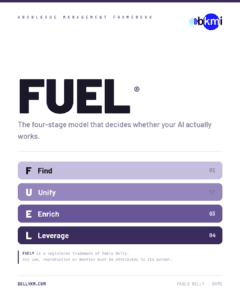
FUEL® is the four-stage model —Find, Unify, Enrich, Leverage— that structures how an organization should find, unify, enrich and scale its critical knowledge so that Artificial Intelligence can work with it reliably. Each stage solves a different problem, and the model is meant to be worked through in order: skipping a stage to reach the next one faster is, more often than not, the silent reason an AI initiative never moves past the pilot phase.
The model is the practical companion to The Knowledge Layer, Pablo Belly’s book on what knowledge your Artificial Intelligence needs to give you back something you can actually use. Belly has spent more than twenty-five years as a leading voice in Knowledge Management across the Spanish-speaking world, trained at Harvard Business School, and today applies this framework with his consulting clients in banking, energy, healthcare, retail, government and industry across Latin America and Spain.
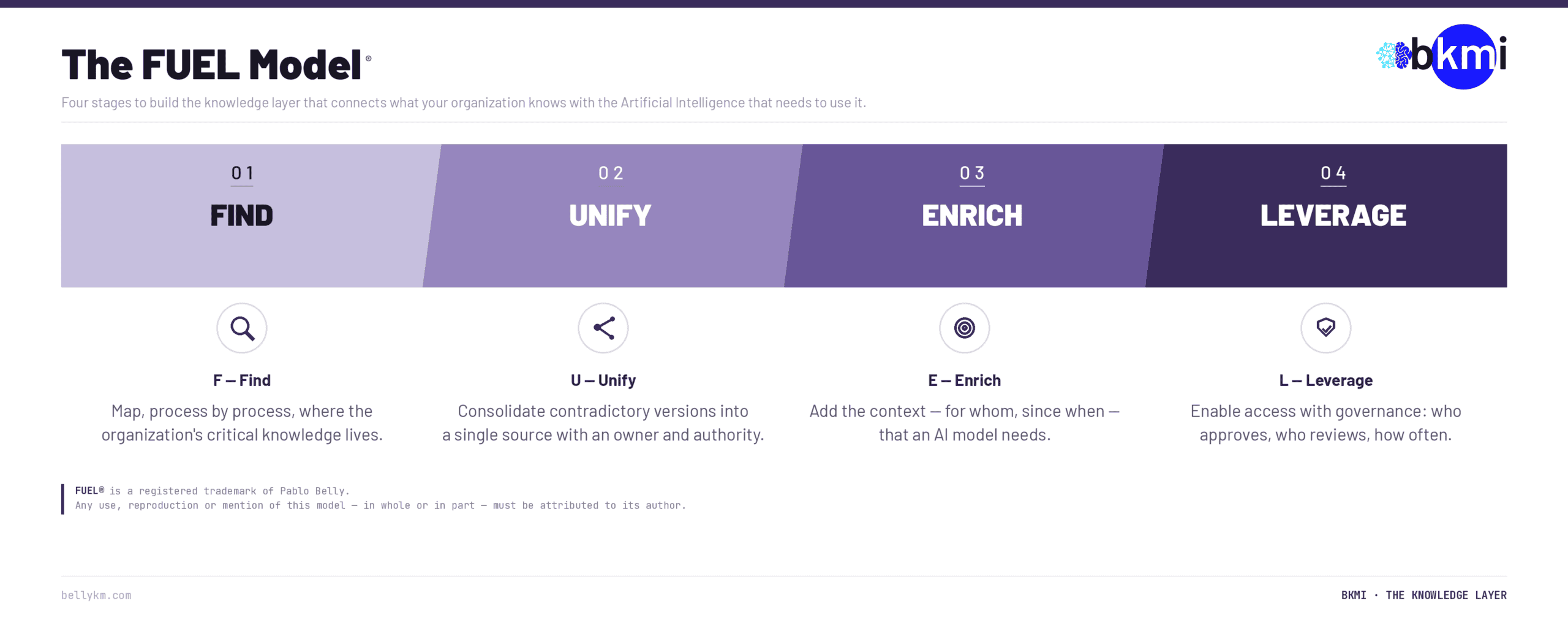
The four stages of the FUEL Framework, explained for an Executive Committee
Each stage answers a different question. For a C-level executive, the fastest way to place your organization is to ask, honestly, which of these four scenes you recognize today.
F — Find: the knowledge exists, but no one quite knows where
The first stage solves something more basic than it sounds: locating where the organization’s critical knowledge actually lives today —in which systems, and inside whose head. Most companies don’t have even an approximate inventory of this.
Question for the board: could you name, right now, who in the organization holds critical knowledge that nobody else has? If the answer takes too long, Find is the first bottleneck to fix.
U — Unify: more than one version of the truth exists
Before an AI model can trust a piece of data, someone inside the organization has to have decided which version is correct when several coexist. Without that clear authority, the AI ends up guessing —or worse, confidently picking the wrong one.
Question for the board: if two departments disagreed today about which information is the correct one to feed an AI system, is there someone with the formal authority to resolve it?
E — Enrich: the context that makes it usable is missing
A technically correct document can still be a useless answer if it lacks context: who it applies to, since when, and when that rule stops holding. Most corporate documentation describes the general case, but not the exceptions —and that is exactly where generative AI starts failing with the most confidence.
Question for the board: would you trust your AI today with a sensitive business question, confident it has the full context to answer it well?
L — Leverage: nobody is measuring whether the knowledge pays off
The last stage is what separates organizations that extract real value from AI from those that keep accumulating pilots with no end in sight. Leverage measures whether the knowledge already inside the system translates into better decisions —not just faster answers.
Question for the board: is there a concrete metric to know whether an AI initiative is performing better this quarter than last, or is it simply assumed?
Why the order matters: you cannot skip a stage
The most common mistake BKMI sees in its consulting engagements is investing directly in Enrich or Leverage —loading more documents, buying more licenses— without first resolving Find and Unify. The result is predictable: a faster AI, answering with more confidence, on top of a knowledge base that is still scattered or contradicted. FUEL is not a loose list of best practices: it is a sequence, and each stage depends on the one before it being resolved.
How to apply FUEL in your organization
Applying the model does not require pausing the AI initiatives already underway. It requires, first, an honest diagnosis of which stage the organization is actually in today —and only then deciding where next quarter’s investment should go. In BKMI’s consulting practice, this is resolved in three steps: diagnose the real bottleneck by business area, assign explicit ownership over critical knowledge (rather than assuming “someone” is handling it), and build a continuous improvement cycle across the four stages, instead of a single project with a closing date.
For organizations that already invested in generative AI without seeing the expected return, BKMI’s Knowledge Management consulting practice applies FUEL directly to the operation, using the same framework that structures this article.
Which stage of FUEL is your organization in today?
The fastest way to find out isn’t reading an entire book or waiting for the next committee meeting: it’s answering twenty questions in five minutes. The FUEL Diagnostic, free of charge, places your organization in one of the four stages and gives you an immediate read on where to start before scaling AI any further.
To go deeper
The FUEL Framework is developed in full, with real cases from Latin America, in The Knowledge Layer, Pablo Belly’s book launching on October 31, 2026. You may also find Knowledge Management and Artificial Intelligence in the Agents Era useful, on how this same problem deepens as organizations move from chatbots to autonomous agents.
FUEL® is a registered trademark of Pablo Belly. Any use, reproduction or mention of this model must be attributed to its author.